
Precision robotics meets the cutting edge of composite manufacturing
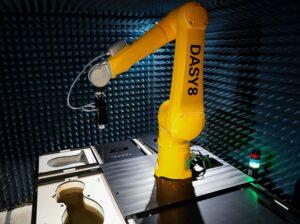
We’re excited to announce that INSPHERE has begun working with Project PABLO (Precision Automated Blade Operation). The project is an Innovate UK-funded collaboration that started this month alongside HAL Robotics, the National Composites Centre (NCC), and Carbon ThreeSixty (CTS). Together, we’re building a new generation of adaptive robotic cutting technology for composite materials, and INSPHERE’s metrology expertise provides a critical datastream into the process.
The problem PABLO solves
Cutting composite materials is still largely a manual affair. Where robots are used, they typically act as “reach enhancers” rather than precision tools ‚ their accuracy limited by mechanical tolerances, drift, and a lack of feedback. Commercial ultrasonic knife (USK) systems exist, but they run open loop: a fixed program executes blind, with no awareness of how the blade is actually interacting with the material. The result is inconsistent edge quality, fraying, and costly rework ‚ a bottleneck that becomes unsustainable as manufacturers scale from thousands to hundreds of thousands of parts a year.
Where INSPHERE comes in
PABLO closes that loop. HAL Robotics’ decode platform brings adaptive, data-driven robot programming. NCC contributes a robotic USK cutting process test bed where blade-drive signatures reveal cut quality in real time. INSPHERE adds the missing dimension – accurate positional metrology, via our IONA system, that compensates for robot drift and pathway deviation. Combined with process adjustment and offline toolpath optimisation, it’s a hybrid control framework that hasn’t existed before. This system is guided throughout by early-adopter CTS, who will help define the quantifiable cut-quality metrics that matter on a real production line.
Bringing the Potential to Life
Ultrasonic knife cutting already earns its place in advanced manufacturing. It slices tough, layered, heat-sensitive materials‚ carbon fibre, honeycomb core, and aramid fabrics cleanly and at speed, without the delamination or fibre breakout that conventional tooling causes. Making that process precise, adaptive and closed loop presents many opportunities.
In aerospace, where every gram and every fibre orientation matters, right-first-time trimming of preforms and structural panels means less scrap and faster qualification. For automotive and EV manufacturing, as carbon-fibre battery enclosures and structural components go mainstream for lightweighting, a scalable, affordable cutting solution is exactly what’s needed to move composites from niche to volume production. Looking at wind energy, precision trimming supports the large-scale composite blade structures the sector depends on, where consistency directly affects performance and lifespan. And across defence and marine applications, where high-performance composites are pushed to their limits, a system that adapts to the part and process in front of it‚ rather than trusting a fixed program‚ is a genuine step change.
For SME manufacturers in particular, PABLO’s promise is a solution that’s precise and accessible . It will eliminate many hours of manual trimming that dominates today’s landscape.
We’re proud to bring our metrology know-how to this consortium and can’t wait to see PABLO’s system move from the development cell at NCC into real production lines. Watch this space for updates as the project progresses.
Interested in how INSPHERE’s precision metrology solutions could support your manufacturing process?
Get in touch at insphereltd.com/contact
If your team is evaluating closed-loop inspection for a current or planned robot cell project, we would welcome the conversation — contact us today.
Publication date: July 2026